The breadth of work on display reflected a research community pushing boundaries across disciplines, from artificial intelligence and global health to immunotherapy and community-based care. Together, the presentations made a compelling case that the next generation of pediatric researchers at Children's National Hospital is already doing work that matters.
Advancing care at the bedside and beyond
Several presenters focused on improving how clinicians detect, diagnose and treat disease in real time. Maria Triantafyllou, MD, a post-doctoral research fellow at the Sheikh Zayed Institute for Pediatric Surgical Innovation, presented work on plasma metabolomic signatures that could sharpen how pediatric sepsis is diagnosed and risk-stratified in the Emergency Department. Working under the mentorship of Ioannis Koutroulis, MD, PhD, MBA, her research points toward a future where metabolic data guides faster, more precise clinical decisions for critically ill children.
Taylor Goodman, MD, introduced the POCUS Pathway, a novel longitudinal curriculum designed to build point-of-care ultrasound skills in pediatric residents. The program, already piloting with residents completing more than 50 scans each, addresses a real gap in procedural training and offers a scalable model for embedding practical skills into residency education.
Maya Gibson, MD, presented findings on blood product utilization in patients, examining how transfusion strategies affect outcomes. Her work contributes to an ongoing institutional effort to optimize care for some of the most critically ill patients in the hospital.
Research with clinical applications
Basic and translational science was well represented among the award winners. Margaret Hines, PhD, presented research on the role of cranial mesenchyme in neural tube closure, work with direct implications for understanding and potentially preventing neural tube defects. Khatereh Khorsandi, PhD, shared findings on reprogramming the immunosuppressive microenvironment to enhance CAR T-cell therapy in diffuse intrinsic pontine glioma, one of the most challenging pediatric brain tumors. Her work explores how the tumor's own defenses can be overcome to make immunotherapy more effective.
Krithika Iyer, PhD, presented a study using ultra-low-field MRI brain volumetry to predict early cognitive risk in low-resource settings, with findings supporting scalable, low-cost neuroimaging biomarkers for developmental screening. Abhijeet Parida, MS, introduced HOPE4KIDS, an AI-based webtool for neuro-oncology segmentation and volumetrics that could expand access to sophisticated imaging analysis. Pooneh Roshanitabrizi, PhD, presented a synthetic dual-channel color Doppler echocardiography approach for detecting rheumatic heart disease in low-resource settings, bringing together imaging innovation and global health impact.
Community, connection and mental health
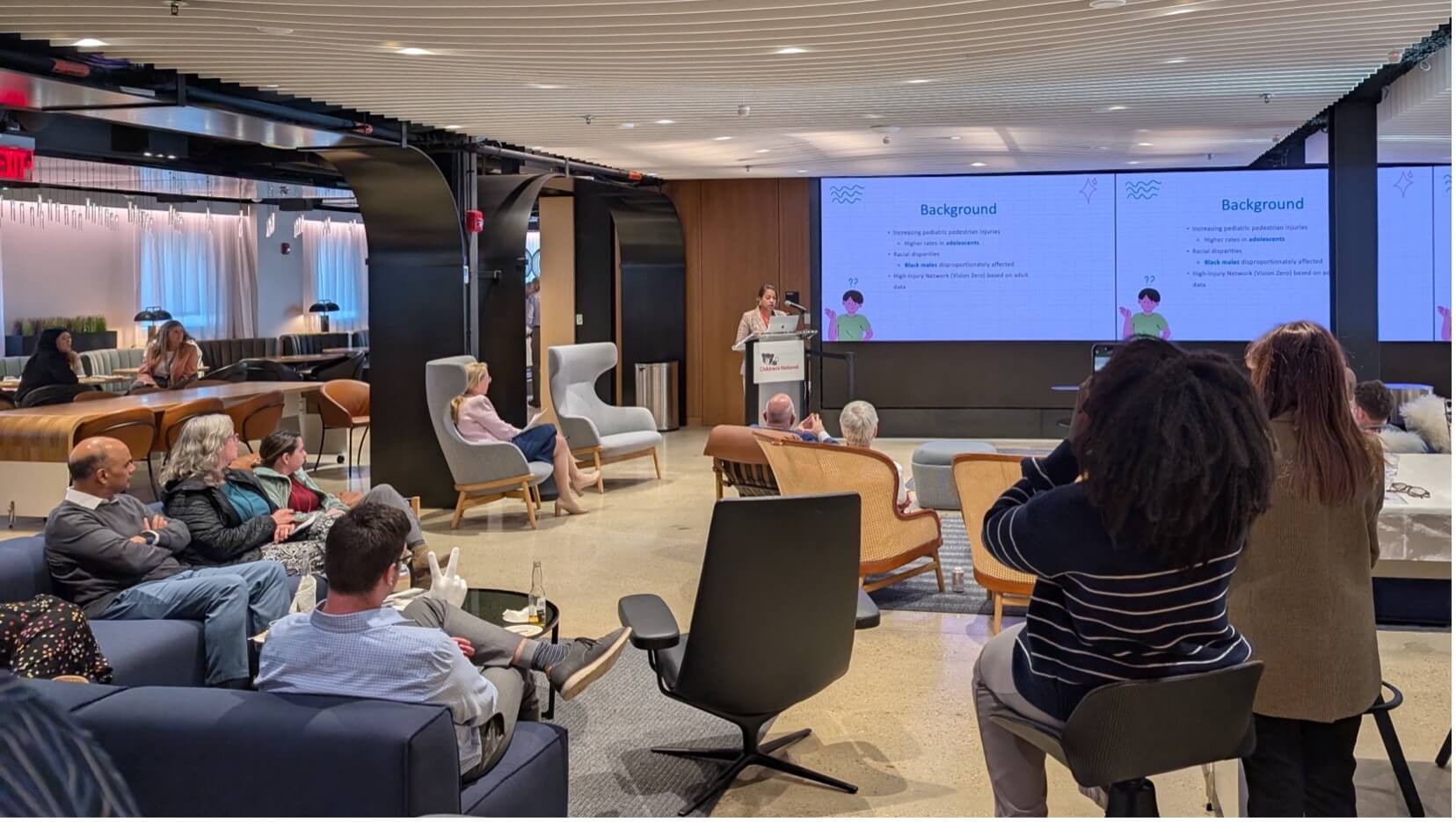
Other presentations turned toward the communities and populations Children's National serves. Brittany Fitzpatrick, MD, MPH, presented data-driven work on pediatric pedestrian safety in Washington, D.C., using 10 years of injury data and geographic mapping to identify patterns and inform prevention strategies. Tininka Rahman, MHA, shared the vision behind establishing a Community Engaged Research and Training Hub at Children's National, a structure designed to deepen the institution's ties to the communities it serves and build more responsive research partnerships.
Zara Hasnani presented research on virus-specific T cell immunity in pediatric patients with inflammatory bowel disease on biologic therapy, examining how treatment affects immune response to common viruses. Megan Lau offered findings from a school-delivered intervention for adolescents with ADHD, tracing how social support functions as a mechanism for improving executive function over time.
The April mixer was a reminder that discovery at Children's National does not only happen in grand auditoriums or flagship publications. It also happens in the work of fellows and residents and staff who show up every day asking hard questions on behalf of children and families. The 12 researchers recognized at this event represent that commitment in full, and their work, spanning the lab, the clinic and the community, reflects exactly the kind of bold, collaborative science that defines this institution at its best.
Contact: William-Jose Velez Gonzalez